Self-Serve Bar Installation for
Restaurant Owners in Florida
Self-Serve Tap Walls for Florida Dining Rooms, Patios, and Waterfront Decks
Self-Service Tap Systems
Guests pour their own beer, wine, and cocktails at the temperature and volume they prefer, while your servers focus on the parts of service that actually require a person.


The Self-Serve Beverage System Built for Florida Dining Rooms
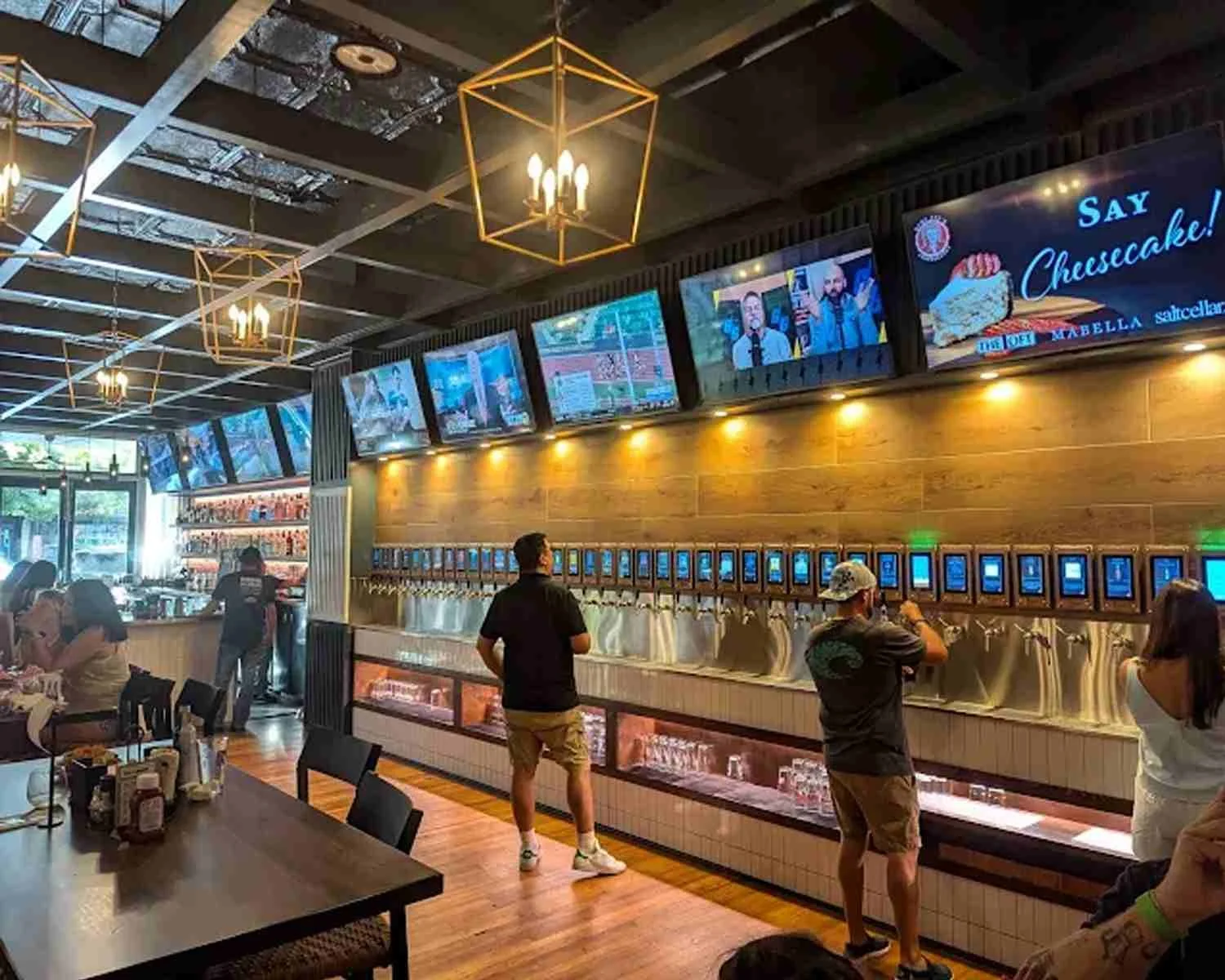
GS Draft builds self-serve systems for Florida restaurants that want a more interactive beverage program without giving up control over quality or product cost. Every ounce is metered, every pour is recorded, and the waste that normally disappears into over-pours and unfinished pitchers becomes a number you can look at on a Monday morning.
For decades the answer to good beverage service has been more experienced staff working faster. That model still works. It has simply become expensive and, in a Florida market where seasonal hiring swings hard between January and September, difficult to staff consistently. Look at where a table actually loses time. The party is seated, someone reads the beer list, the server comes back twice, the order goes in, and the drinks arrive eleven minutes after the guests sit down. Multiply that across a 140-seat room on a Saturday in season and you are looking at the difference between three turns and four. Self-pour moves that transaction off your service staff entirely for the guests who want it. They pour, they sit down, and your team handles the food, the floor, and the tables that need attention.
Self-Pour Technology Engineered
for Florida Restaurant Service
Whether the installation is a self-pour beer tap wall system or a self-serve kiosk, a customer-operated dispensing station gives guests their preferred beverage at the correct temperature while taking pressure off your team. It also produces consistency that a busy bartender on a Saturday night cannot match by hand. The features below are what separate our systems from the alternatives:
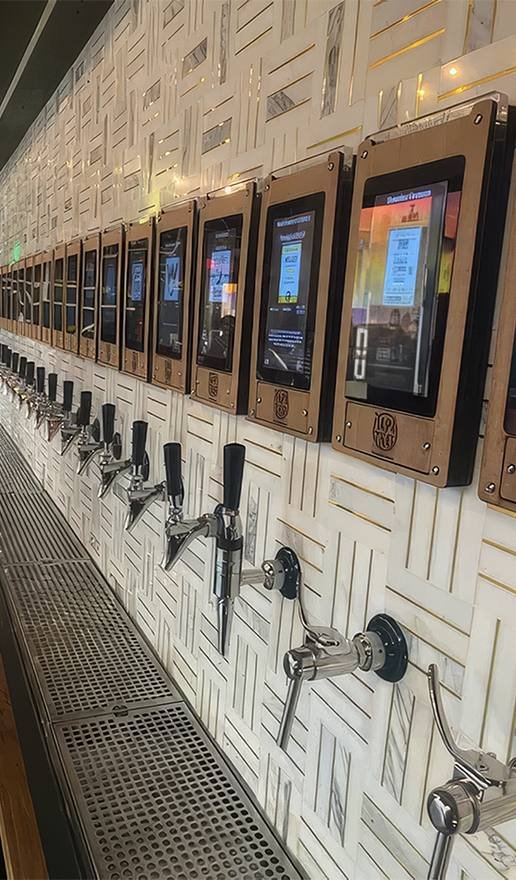
Refrigeration Engineered for the Patio, Not Just the Dining Room: Long draw systems tied into a walk-in, or compact direct draw where floor space is limited. We build to your layout. Glycol-cooled trunk lines hold every beverage at its correct serving temperature from keg to faucet, which matters more in Florida than almost anywhere else. A covered patio in Naples or a waterfront deck in Sarasota is running at ambient conditions that will destroy the quality of a pour traveling any real distance through an underspecified line. Direct sun on a tower is its own problem, and we place and shade accordingly.
A Lineup Your License Actually Permits: Craft beer, wine, cocktails, kombucha, cold brew, hard seltzer, and non-alcoholic options can all run through the same wall. What your wall can legally carry depends on your license class, and for restaurants that question is more interesting than it is for bars. A 2COP covers beer and wine only. Spirits require a 4COP or, more commonly for Florida restaurants, a 4COP SFS. Settling this crucial requirement prior to the design stage prevents costly configuration errors before equipment is even specified.
Menus That Answer the Questions Your Servers Keep Getting: Each station carries a digital menu that lets guests browse the beverage lineup, compare styles and ABV, and choose without waiting for a recommendation. Tasting notes and brewery information sit one tap away.By automating the pour, you return valuable minutes to your floor staff during intense rushes, allowing them to focus entirely on guest hospitality.
RFID Access and the Record It Leaves: Cards, wristbands, or other authorized controls govern who dispenses and how much. Florida prohibits alcohol sales by vending machine, so the RFID card or wristband is not a convenience, it is what makes the system legal. Staff check ID before issuing one, dispense limits sit around 32 ounces before reauthorization, and every ounce is attached to a guest. If a question about service ever arises, you have a record rather than a recollection.
Pour Cost You Can Actually See: Live reporting shows what is moving, what is not, and what is sitting in a keg past its prime. Restaurant beverage programs have historically carried a gap between theoretical and actual pour cost that nobody could fully explain. Metered dispensing closes it, and a slow-moving line gets identified in days rather than at the end of the quarter.
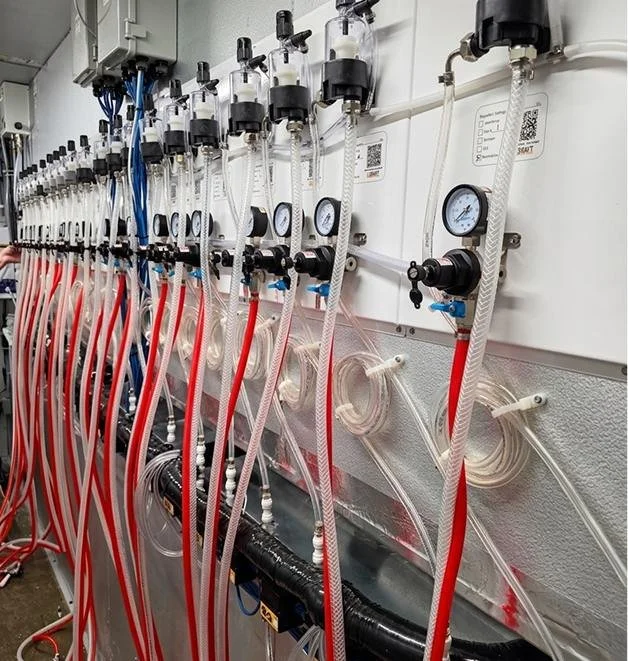
Self-Serve Beverage Design, Installation, and Service for Florida Restaurants
GS Draft installs self-serve beverage systems in restaurants, bars, breweries, and entertainment venues throughout Florida. The result is a beverage program guests engage with directly and a staff freed to work where they are most valuable. Our team stays involved from the first design conversation through years of service afterward.
-
First-time self-pour installations and upgrades to an existing program both benefit from planning before equipment gets ordered. Our designers work from your floor plan, your service volume, and your budget. Practical questions get settled early: how many lines the menu actually needs, where the cooler sits relative to the wall, whether tower placement creates a queue that crosses your server path or blocks the route to the restrooms, and how an outdoor or covered patio installation should be handled given Florida humidity and direct sun.
Proactive financial modeling is essential for any venue utilizing a 4COP-SFS license. Since these specific permits tie your legal compliance to a mandatory minimum ratio of food and non-alcoholic sales, you must anticipate the revenue impact of your draft system. A self-pour configuration will drastically lift your beverage volume; mapping this growth in advance ensures your new revenue stream supports your business without threatening your liquor license.
-
Our systems are engineered so the install itself is flawless. Once equipment arrives at your Florida location, trained technicians complete the work, including specialized and custom configurations, and confirm every component is set correctly before the system goes into service. Gas pressures are set per product, lines are balanced, and the system is tested under load rather than signed off on a single pour. In Florida that test includes cooler recovery, because a walk-in with a back door opening every ninety seconds through an August dinner rush behaves nothing like it does at 10am.
-
Draft systems degrade quietly. Line cleaning and scheduled inspection are what keep a system pouring the way it did on opening day, and skipping them shows up first in flavor and later in equipment failure. GS Draft provides ongoing maintenance so your self-serve bar performs over the long term rather than declining month by month until someone notices. For Florida restaurants, we shorten the trunk line inspection interval, because humidity is harder on jacketing here than the manufacturer's schedule assumes, and we build in a storm-season shutdown and restart procedure so a three-day outage does not cost you a week of bad pours.
What a GS Draft Self-Serve Bar Adds to a Florida Dining Room

Customizable

Professional Service

Advanced Technology
Can We Add a Self-Serve Bar to Your Florida Restaurant?

A self-serve bar from GS Draft gives your guests a better beverage experience while improving how efficiently the room runs and what it returns. We work across the state, from the Panhandle through Tampa Bay, Orlando, Southwest Florida, and South Florida, with a wide range of establishments:
Bars and Restaurants || Pizzerias || Breweries || Specialty Beer and Wine Retailers || Grocery and Convenience Stores || Sports and Entertainment Venues || Hospitality Locations || Luxury Apartment Complexes || Corporate Offices || & more
Florida Restaurant Self-Serve Bar FAQs
A self-serve bar is a draft dispensing system that stores beer, wine, and cocktails in kegs and serves them directly to guests, holding temperature and pressure at the correct levels so every pour is consistent. Guests use a digital menu and controlled dispensing hardware to serve themselves, which shifts your staff toward the parts of hospitality that require judgment. For restaurants carrying a broad beverage list, it also removes the bottleneck of a single bartender during a rush.
At minimum a 2COP, which covers beer and wine for on-premises consumption and is not limited by county quota. That supports a strong wall across beer, cider, seltzer, wine, kombucha, cold brew, and non-alcoholic lines, but not spirits. For cocktails you need full liquor privileges, either a 4COP quota license or a 4COP SFS. The SFS route is the one most Florida restaurants take, and it carries operating conditions around food revenue share, square footage, and seating capacity that you have to keep meeting after you build. Confirm your position with ABT or your beverage attorney before committing to a self-serve draft system.
Two systems operate together, and it is worth separating them. Gas, either CO2 or nitrogen, applies pressure to the keg and pushes the beverage through the line to the faucet. Cooling is handled independently, either by a direct draw setup where the taps sit on the cooler itself, or by a long draw system where glycol circulates alongside insulated trunk lines to hold temperature across distance. Guests then pour their own serving with minimal staff involvement, which produces consistent quality while reducing the labor a full-service bar requires.
It removes the drink order from the critical path for the guests who use it, which is where most of the time is recovered. The party pours on arrival instead of waiting through two server trips. It also front-loads beverage spend, since guests who serve themselves tend to order in smaller measures more often rather than in fewer large rounds. The gain is real but it is not automatic, and it depends heavily on where the wall sits relative to your host stand and your dining room.
CO2 is used for carbonated products, including craft beer, sparkling wine, cider, hard seltzer, and carbonated cocktails, because it maintains carbonation levels through service rather than allowing the product to flatten in the line. Nitrogen is used for still beverages such as red and white wine, cold brew, and nitro coffee, and it typically runs at higher operating pressure. Nitro stouts use a blend of roughly 25% CO2 and 75% nitrogen, which produces the dense cascade and soft mouthfeel the style is known for.
Yes. A single system handles both, provided the gas source and pressure are configured per product rather than set uniformly across the wall. That configuration is part of the install. The practical benefit is a broader menu, which in Florida frequently means running cold brew and kombucha next to beer and seltzer without compromising any of them, and it gives your driving guests a real option instead of a soda gun.
A complete system includes keg couplers, beverage and gas tubing, primary and secondary gas regulators, beer FOBs, glycol-cooled and insulated trunk lines, a glycol power pack, tap towers with faucets and drip trays, and heavy-duty stainless fittings and clamps. Each part plays a role in pressure, temperature, or sanitation, and a weakness in any one shows up in the glass. On coastal Florida builds, exposed fittings and clamps should be specified up rather than down, since salt air reaches further inland than most operators expect.
Maintenance is scheduled work, not reactive work. Recommended intervals include glycol power pack service and cleaning every six months, regular sanitizing of beverage lines, replacement of vinyl beer lines every 12 to 24 months, frequent cleaning of faucets and keg couplers, inspection of glycol trunk lines for wear or damage, and servicing beer FOBs twice per year. Florida operators should pay particular attention to the trunk line inspection, since heat and humidity accelerate wear on insulation and jacketing. Following the schedule reduces downtime and extends the working life of the system. Learn more here.
Leaving beverage lines warm during an extended Florida power outage creates a severe line-cleaning emergency long before it impacts pour quality. Stagnant, heated product quickly degrades into a major bacterial hazard, meaning a fast reopening requires a proactive operational playbook. To protect your draft assets and resume service immediately after a hurricane, venues must execute a strict, pre-planned sequence: flushing lines to prevent spoilage, isolating gas main valves, and safely powering down glycol chillers to avoid grid surges. Managing these critical technical steps before landfall ensures that when the power returns, stabilizing your temperatures and pressure balances takes hours, not days.
Every two weeks with a caustic cleaning solution, plus an acid cleaning twice per year. This is the interval that keeps bacteria, yeast, and mineral buildup from establishing inside the cooler and draft lines. It is also the maintenance item most often allowed to slip, and the one guests notice fastest, because a neglected line affects flavor well before anything visibly goes wrong. A consistent schedule protects both the quality of the pour and the reputation attached to it. Learn more here.
For a restaurant working to improve both guest experience and operating efficiency, the returns show up in several places:
- Every drink is served at its correct temperature, producing a consistent pour glass after glass.
- A wider range of beer and specialty beverages, giving guests with different preferences something they want.
- Self-pour access during peak periods, which shortens waits and removes pressure from staff at exactly the hours it matters.
- Reduced packaging waste, since keg dispensing replaces bottles and cans and lowers the volume of material your operation pays to haul away.
- A per-guest consumption record, which is worth having in a state where questions about service are taken seriously.
Start with the constraints rather than the equipment. Dining room size, the number of beverage lines your menu genuinely requires, available floor and counter space, and your refrigerated storage capacity will determine most of the answer. Distance between the cooler and the intended tap location decides whether you are looking at direct draw or long draw, and that decision carries the largest cost difference in the project. In Florida that distance is often longer than planned, since the cooler is inside and the patio is where you actually want the wall.
Our systems accommodate 1/6 barrel, 1/4 barrel, and standard 1/2 barrel kegs, along with Euro kegs. That range matters for a Florida beverage program, since it lets you carry limited-release products from a local brewery in a sixtel alongside the high-volume selections that need a half barrel, without the keg format dictating what goes on the menu. It matters more here than in a steady market, because your turn rate changes dramatically between February and July and a keg sized for season will go flat out of it.
Most performance complaints trace back to temperature, either in keg storage or somewhere along the dispensing path, and foam is the usual symptom. After that, the frequent causes are dirty lines, incorrect gas pressure, and imbalance between components. Our support team works through these with operators, and in many cases the diagnosis can be narrowed over the phone before a technician is dispatched.
Recurring equipment failures, inconsistent drink quality, or a system that cannot keep pace with your volume are all reasons to look at replacement. A further consideration applies to venues that have grown their beverage program since the original install, since a wall built for eight lines becomes a constraint on the menu once you want sixteen. Current self-pour technology improves efficiency, lowers product waste, and produces a better experience for guests and staff alike.
Cost is determined by the number of tap lines, the overall system design, and whether the installation is a direct draw setup with taps mounted on the cooler or a long draw system with glycol-cooled trunk lines and remote dispensing towers. The second is more involved and more expensive, and it is also what most Florida venues require once any distance separates the cooler from the bar. Coastal and open-air builds carry a materials premium for corrosion-resistant hardware, which pays for itself somewhere around the eighteen-month mark. We work directly with restaurant owners to produce an accurate estimate built around the space and the budget. Please contact us for a free quote.