
What the 2026 FIFA World Cup Proved About High-Speed Stadium Beer Dispensing: The QuickTap Case Study

Every stadium concession operator knows the moment. The halftime whistle blows, tens of thousands of fans stand up at once, and a wall of people converges on the concourse with roughly fifteen minutes to buy a drink before play resumes. What happens in those minutes decides whether a venue captures the demand it spent all season building, or watches it walk away in the form of an abandoned line.
That pressure has always been the real test of stadium beverage operations. It isn't the quiet stretches that separate a profitable concession program from an underperforming one; it's the surge. And during the 2026 FIFA World Cup, that surge became the setting for one of the most revealing real-world tests of high-volume beer dispensing the industry has seen. Across three of Mexico's largest venues and 13 tournament matches, Grupo Modelo ran GS Draft's QuickTap Mobile Units head-to-head against traditional multi-tap draft stations, and the results reframe what operators should expect from a modern fast beer tap system.
This is not a product overview. It's a look at what the case study data actually shows, why it matters operationally, and what stadium operators can take from it.
The Challenge of Serving Thousands of Fans in Minutes
Peak-demand beverage service is a throughput problem disguised as a staffing problem. When thousands of fans reach the concourse at the same moment, the constraint isn't how much beer is in inventory; it's how fast that beer can move from keg to cup to customer. Traditional draft systems were never engineered for that kind of compression.
The bottlenecks are familiar to anyone who has run a concession stand during a major event. Lines back up because each pour takes too long. Foaming and slow taps drive up keg waste, quietly eroding margin one over-poured cup at a time. Labor is finite; a venue can only fit so many people behind a fixed bar, and hiring more staff doesn't help when the taps themselves are the limiting factor. Concession space is finite too, so operators can't simply add more stations to a concourse that's already full. And when the line gets long enough, fans do the math and give up, and every abandoned line is revenue that was available and lost.
That's why dispensing speed is so closely tied to profitability. In a normal retail environment, a slow transaction is an inconvenience. In a stadium with a hard halftime window, a slow transaction is a sale that never happens. The question the 2026 FIFA World Cup put to the test was simple: what if the dispensing technology itself was fast enough to keep the surge from ever forming?
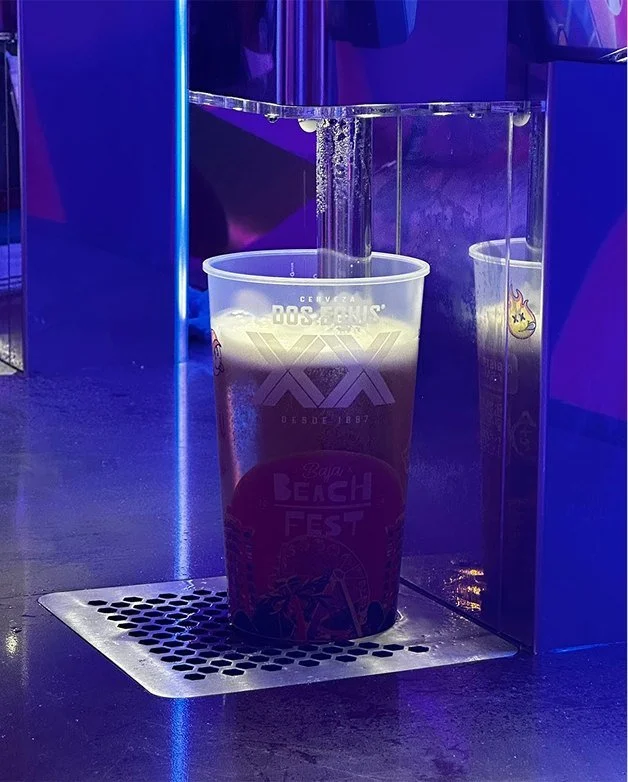
How Grupo Modelo Tested QuickTap During the 2026 FIFA World Cup
A global tournament is a near-perfect laboratory for this. Attendance runs high, demand spikes are severe and predictable, and the stakes for getting service right are enormous. Grupo Modelo used exactly that environment to evaluate QuickTap under genuine, sustained pressure rather than a controlled demo.
The deployment spanned three of Mexico's premier venues, Estadio Azteca in Mexico City, Estadio Akron in Guadalajara, and Estadio BBVA in Monterrey, across 13 FIFA World Cup matches. Crucially, this wasn't a solo trial. At each venue, QuickTap Mobile Units were positioned directly against traditional multi-tap draft stations serving the same crowds under the same conditions. That side-by-side design is what makes the numbers meaningful: both systems faced identical demand, so the differences in output reflect the dispensing approach itself, not a lucky matchup or a soft test.
QuickTap vs. Traditional Draft Systems
The most counterintuitive part of the comparison is where it starts. The traditional stations ran twenty-four taps. The QuickTap units ran four. On paper, that looks like a six-to-one disadvantage. In practice, it exposed how misleading tap count is as a measure of serving capacity.
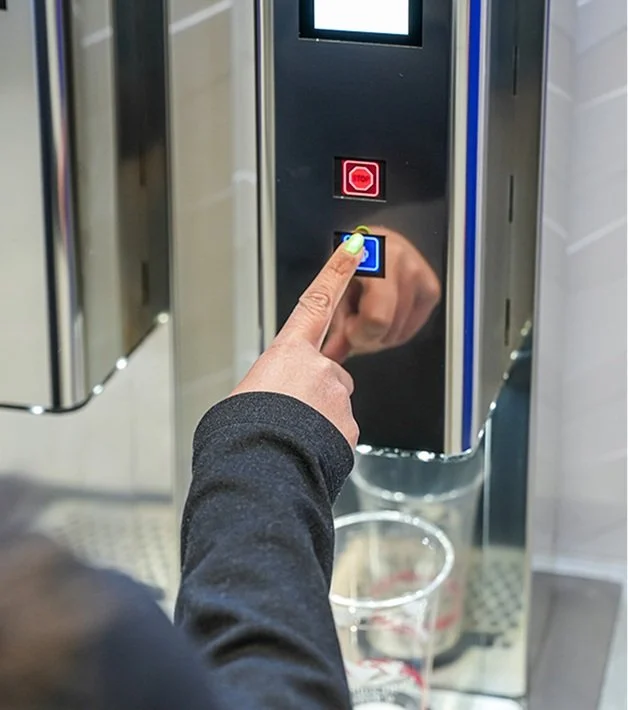
What QuickTap traded in tap quantity, it made up in pour speed and mobility. Each unit delivered a full 24 oz pour in about seven seconds, turning what is normally the slowest step in the transaction into the fastest. That speed is the whole story behind the smaller footprint: when a single tap can clear customers this quickly, four of them move more people than twenty-four conventional taps struggling against foam and refill delays. Throughput per tap matters far more than the raw number of taps, which is exactly what the engineering behind QuickTap's fast beer taps for high-volume venues is built to maximize. The result was faster customer throughput from a fraction of the equipment, and it held up shift after shift instead of fading once the opening rush passed.
Mobility compounded the advantage. A mobile dispensing architecture means service can go to the demand rather than forcing the demand to find a fixed bar, which is what lets a venue relieve pressure on crowded concourse areas without building new infrastructure. And the speed came without the usual trade-off in waste: QuickTap held keg waste to less than 1%, so the throughput gains didn't quietly leak back out as spillage and over-pour. Each of these advantages maps to a specific operational pain: the smaller footprint addresses limited space, the pour speed addresses the halftime window, the low waste addresses answers margin erosion, and mobility addresses fixed-station bottlenecks.
The Results That Changed Stadium Beverage Operations
What the Operational Numbers Mean
Across the tournament, QuickTap served 1,300 kegs and poured 52,000 individual 24 oz beers over 13 matches at three stadiums, with keg waste held below 1% the entire time. Those figures are worth sitting with, because volume at that scale usually comes at a cost. High-throughput dispensing tends to get messy: rushed pours, more foam, more waste. Holding waste under 1% while moving 52,000 pours means the speed didn't come from cutting corners on the product. Operationally, that's the difference between a system that can absorb a surge and one that merely survives it. Nearly every ounce that left a keg reached a paying customer, which is precisely the efficiency that peak-demand service demands and traditional systems rarely deliver.
The Revenue Comparison
The commercial gap is where the test becomes undeniable. Over the same matches, QuickTap generated approximately $925,480 in revenue. The traditional draft stations generated approximately $231,370. Put plainly, QuickTap produced roughly 300% more revenue while using 66% fewer taps.
That combination is the entire point. More revenue from less equipment isn't a marginal efficiency gain; it's a fundamentally different relationship between footprint and output. The traditional stations weren't failing for lack of taps; they were failing because tap count can't overcome slow pours when the clock is against you. Speed converted waiting fans into completed sales, and the revenue reflects exactly that conversion.
Stadium-by-Stadium Results
The tournament-wide totals hold up because they repeat at the venue level. Each stadium tells the same story in its own way.
Mexico City Stadium (Estadio Azteca)
Across five matches, QuickTap generated $377,000 in revenue against $94,250 from the traditional stations. The gap here wasn't only about QuickTap selling more; it was also about what the traditional setup lost. Those stations saw lower sales volume, and higher keg waste further eroded whatever profitability they managed to capture, widening the gap between the two systems on both the top and bottom lines.
Guadalajara Stadium (Estadio Akron)
Over four matches, QuickTap brought in $274,240 versus $68,560 for the traditional draft. The clearest operational win at Estadio Akron was the disappearance of line abandonment. By moving fans through the concession area significantly faster, QuickTap kept people in line who would otherwise have given up, recovering the exact sales that slow service normally forfeits during a rush.
Monterrey Stadium (Estadio BBVA)
Also across four matches, QuickTap produced $274,240 against $68,560 from the traditional stations. What stands out at Estadio BBVA is how it handled halftime demand without adding labor. The surge was absorbed by the unit’s speed, not by throwing more staff at the problem, a distinction that matters enormously to operators for whom labor is both scarce and expensive.
Why These Results Matter for Stadium Operators
Strip away the tournament setting, and the case study becomes a fairly direct statement about how to run high-volume beverage service. The measurable outcomes point to a repeatable set of business benefits rather than a one-off result.
The revenue data shows how much concession income is left on the table by dispensing speed alone, and how mobile draft beer stations can recover it. Faster service directly reduces wait times, which improves the fan experience and, not coincidentally, keeps more fans in line long enough to buy. GS Draft's resources on fast beer taps for stadiums and large-venue concessions break down how these tournament-scale gains translate into a specific venue plan, mapping pour speed and footprint against peak-window staffing so operators can model the impact before committing. The sub-1% keg waste protects profit margins on every keg, so volume growth isn't eaten by spillage. The smaller footprint means a venue can serve more customers without expanding concession space, a rare lever in facilities where square footage is fixed. And the ability to meet halftime demand without extra staff is exactly the kind of operational efficiency that peak-demand service has always struggled to achieve.
None of this is unique to soccer or to Mexico. The same dynamics govern any environment where large crowds arrive with limited time to buy. Stadium operators, sports venues, arenas, concert venues, large entertainment facilities, and high-volume concession operators of every kind face the same halftime-window problem in different costumes. The case study simply happened to test it at World Cup scale, which is about as demanding a condition as the industry offers.
The 2026 FIFA World Cup left little room for doubt. Across 13 matches at three major stadiums, with demand as intense as high-volume beverage service ever gets, high-speed dispensing produced roughly 300% more revenue from 66% fewer taps while keeping waste under 1%. These are operational outcomes measured in the field, not projections from a spec sheet. For any operator wrestling with long concession lines, thin peak-hour margins, or the physical limits of their concourse, GS Draft's high-speed draft beer dispensing built for stadiums turns that tournament evidence into a practical plan, showing how pour speed, footprint, and staffing come together for a specific venue. The takeaway is that the dispensing technology itself is a lever worth pulling, and the results give operators a data-backed starting point for rethinking how they handle the next high-volume event.